Most 5-axis machines that disappoint were not inaccurate. They were the wrong size.
The part clipped the enclosure on the first tilt. Nobody weighed the fixture. The tool was 180 mm long and the spindle nose could not climb high enough. Those machines do not get sent back — they get parked in the corner running three-axis work, which costs more than returning them. And all of it was visible in the spec sheet.
So this guide skips the theory — our types of 5-axis CNC machines article covers that. Here are four numbers to measure on your part, then the published specifications of eight trunnion style machining centers.
Most buyers read the table diameter, decide “Ø400 sounds right,” and move to spindle speed. Then the machine arrives and the part does not fit. Here is the order that works.
Table size is the disc your fixture bolts to. Swing diameter is the circle your workpiece can sweep through while tilting and rotating without hitting anything. Sometimes they are far apart.
Measure the largest diameter your part traces when it spins — fixture, clamps and uncut stock included. That number goes against the swing column, not the table column.
Leave 15 to 20 percent of headroom. A part that sweeps 480 mm technically fits a 500 mm swing.
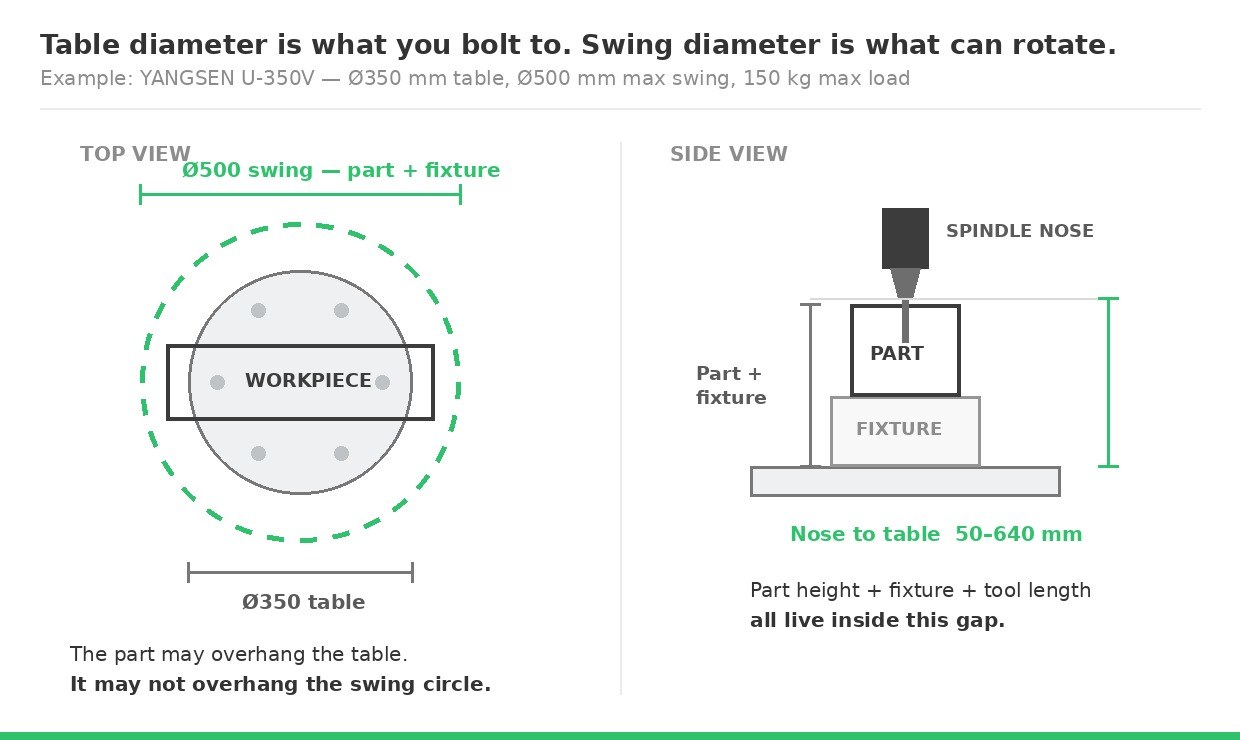
Table load capacity is not part weight. It is everything above the table face: part, fixture, clamps, vise, tombstone. A steel plate for a 20 kg aluminium housing can weigh 25 kg on its own. Estimating rather than weighing? Multiply by 1.5 to 2.
This matters more on a trunnion than on a flat rotary table, because the load is not sitting still — it is tilted through ±110° or ±120° and accelerated by two axes. The published figure is static. An overloaded trunnion shows up as chatter in the finish pass long before anything breaks.
The published spindle-nose-to-table range has to swallow three things stacked on each other: fixture height, part height, and your longest tool including the holder. A 200 mm part on a 100 mm fixture with a 250 mm tool assembly needs 550 mm — that alone rules out three machines here.
And remember the tilt. At 90°, your part height becomes your part width, and the clearance you needed moves to a different axis.
Most parts never exceed ±90°. If yours is one of them, do not pay for more.
Undercuts, negative draft and features below the parting line need the tilt axis to go past vertical. Every model here gives ±110° or ±120°. The U-400D publishes -20~±110° — extra reach on the negative side that mould makers care about more than anyone else.
One more decision belongs here: simultaneous 5-axis, or 3+2 positional? For many shops the honest answer is 3+2. Read 3+2 positional vs simultaneous 5-axis machining first — it changes your control and CAM requirements more than it changes the machine.
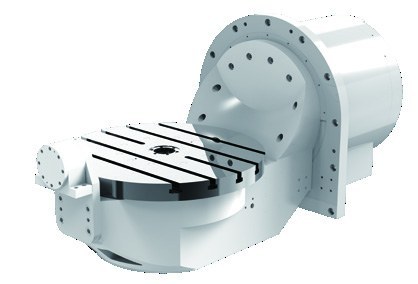
A trunnion (or cradle) carries the workpiece on a tilting axis mounted between two supports, with a rotating C-axis platter inside it. The part tilts and turns; the tool does not. Supported on both sides instead of cantilevered, it is the stiffest way to get five axes under a small or medium part — and the trade-off is size, because heavier parts need a dramatically stronger cradle.
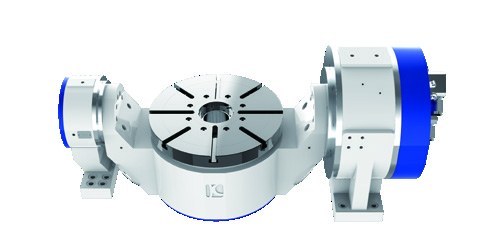
Table A: will my part fit and can the table hold it. Table B: can it cut at the rate I need. Table C: published rotary-axis accuracy. All eight sit inside the wider 5-axis machining center range.
Run your four numbers down this table. It usually eliminates five or six of the eight before you look at a single spindle specification.
|
Model |
Structure |
Table Size |
Swing Ø |
Max Table Load |
Rotation Angle |
Spindle Nose to Table |
|
U-260T |
Drill-Tap |
Ø260 |
400 mm |
80 kg |
A/C ±110° / 360° |
100–510 mm |
|
U-320V |
Vertical |
Ø320 |
500 mm |
120 kg |
A/C ±120° / 360° |
50–640 mm |
|
U-350V |
Vertical |
Ø350 |
500 mm |
150 kg |
A/C ±120° / 360° |
50–640 mm |
|
YS-650-5X |
Ram-Type |
Ø650 |
650 mm |
300 kg |
B/C ±110° / 360° |
150–600 mm |
|
U-400D |
Bridge-Type |
Ø400 |
590 mm |
300 kg (H) / 200 kg (V) |
A/C -20~±110° / 360° |
60–560 mm |
|
U-400 |
Gantry-Type |
Ø400 |
590 mm |
300 kg (H) / 200 kg (V) |
A/C ±110° / 360° |
150–600 mm |
|
U-700 |
Gantry-Type |
Ø560 |
850 mm |
350 kg |
A/C ±120° / 360° |
150–650 mm |
|
U-900 |
Gantry-Type |
Ø850 |
1,200 mm |
1,200 kg |
A/C ±120° / 360° |
130–730 mm |
|
Model |
X/Y/Z Travel (mm) |
Spindle |
Speed (rpm) |
Power S1/S6 (kW) |
Rapid (m/min) |
A/C Speed (rpm/min) |
Control |
Footprint L×W×H (mm) |
|
U-260T |
600/450/410 |
BT30 DDS |
20,000 |
3.7 / 5.5 |
24/24/24 |
50/80/100/250 |
Huazhong / Syntec |
2300×2850×2750 |
|
U-320V |
700/590/590 |
BBT40 DDS |
12,000 |
11 |
30/30/30 |
110/218/100/176 |
Huazhong / Syntec |
2480×3260×2900 |
|
U-350V |
700/590/590 |
BBT40 DDS |
12,000 |
11 |
30/30/30 |
110/218/100/176 |
Huazhong / Syntec |
2480×3260×2900 |
|
YS-650-5X |
680/500/450 |
HSK-A63 motorized |
20,000 |
20 / 25 |
36/36/36 |
50/100 |
SIEMENS-ONE |
3000×3000×3500 |
|
U-400D |
1050/570/500 |
HSK-A63 motorized |
18,000 |
30 |
30/30/30 |
47/88.5 |
Siemens / Syntec / HNC |
3500×3300×3200 |
|
U-400 |
460/550/450 |
HSK-A63 motorized |
20,000 |
15 |
30/30/30 |
45/85 |
HNC / Syntec / Siemens / Heidenhain |
3900×1780×2900 |
|
U-700 |
700/800/500 |
HSK-A63 motorized |
20,000 |
15 |
30/30/30 |
30/30 |
HNC / Syntec / Siemens / Heidenhain / FANUC |
3600×2500×3500 |
|
U-900 |
950 / 900+160 / 600 |
HSK-A63 motorized |
18,000 |
30 |
30/30/30 |
60/70 |
SIEMENS-ONE / Heidenhain |
3900×2500×3300 |
Rotary axes, in arc-seconds.
|
Model |
Positioning Accuracy |
Repeatability |
|
U-260T |
A/C 16 / 10 ″ |
A/C 5 / 5 ″ |
|
U-320V |
A/C ±8 / ±5 ″ |
A/C 5 ″ |
|
U-350V |
A/C 20 / 20 ″ |
A/C 4 / 4 ″ |
|
YS-650-5X |
B/C 10 / 10 ″ |
B/C 4 / 4 ″ |
|
U-400D |
A/C 20 / 10 ″ |
A/C 4 / 4 ″ |
|
U-400 |
A/C 20 / 10 ″ |
A/C 4 / 4 ″ |
|
U-700 |
A/C ±10 / ±10 ″ |
A/C ±2 ″ |
|
U-900 |
A/C 8 / 8 ″ |
A/C 4 / 4 ″ |
These are angular figures. They do not convert cleanly into a millimetre tolerance, because the error you see depends on how far the feature sits from the centre of rotation. A 10-arc-second error is roughly 0.005 mm at a 100 mm radius and roughly 0.024 mm at 500 mm. Same machine, very different consequence.
Published parameters are subject to change. Ask for the current specification sheet before you quote.
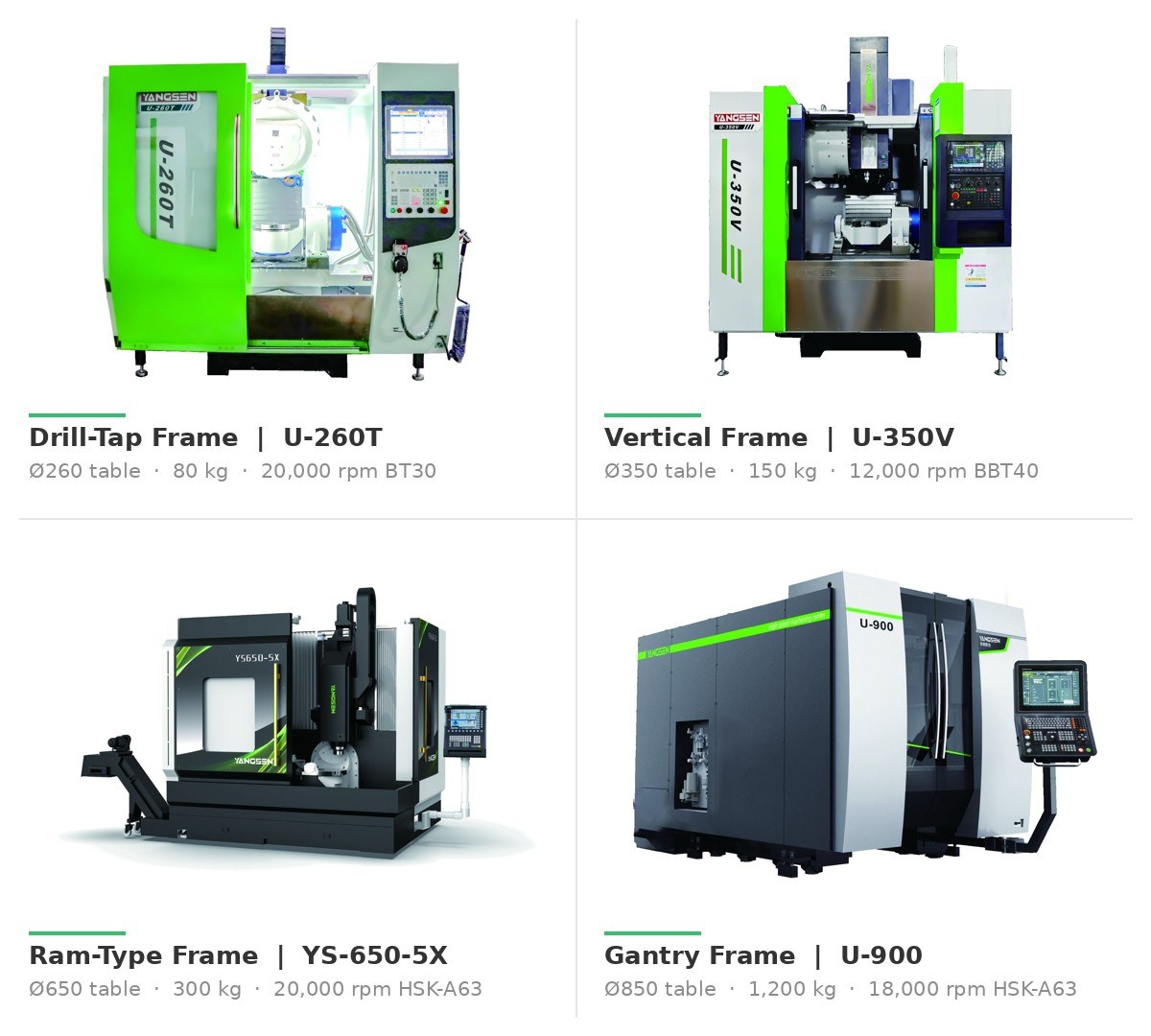
Drill-tap frame — U-260T → small aluminium 3C and hardware, high volume. BT30 at 20,000 rpm, rotary table to 250 rpm/min. Cycle time is the whole conversation here. Do not over-buy: a bigger table only adds rotating mass and slows you down.
Vertical frame — U-320V / U-350V → stainless and precision mechatronic parts. Near-identical twins: same envelope, same 11 kW / 47 Nm spindle, same footprint, same 500 mm swing. The differences are the disc (Ø320 vs Ø350) and capacity (120 vs 150 kg). So weigh your fixture — under 120 kg either works; over it, U-350V.
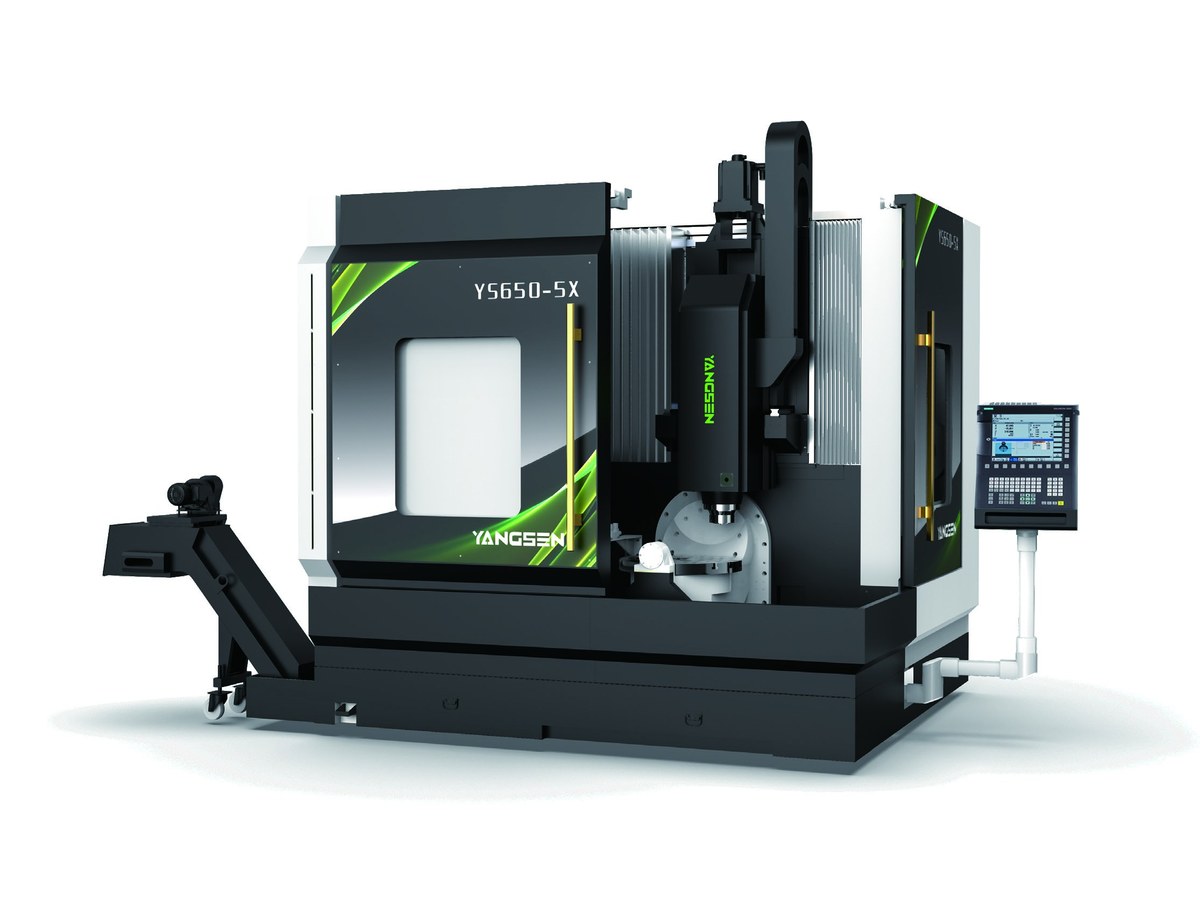
Ram frame — YS-650-5X → airframe and UAV structures where the tool has to reach. The ram gets the spindle into deep pockets and awkward geometry without absurd stick-out, and at 36/36/36 m/min it has the fastest rapids in the range. Note its tilting axis is designated B, not A.
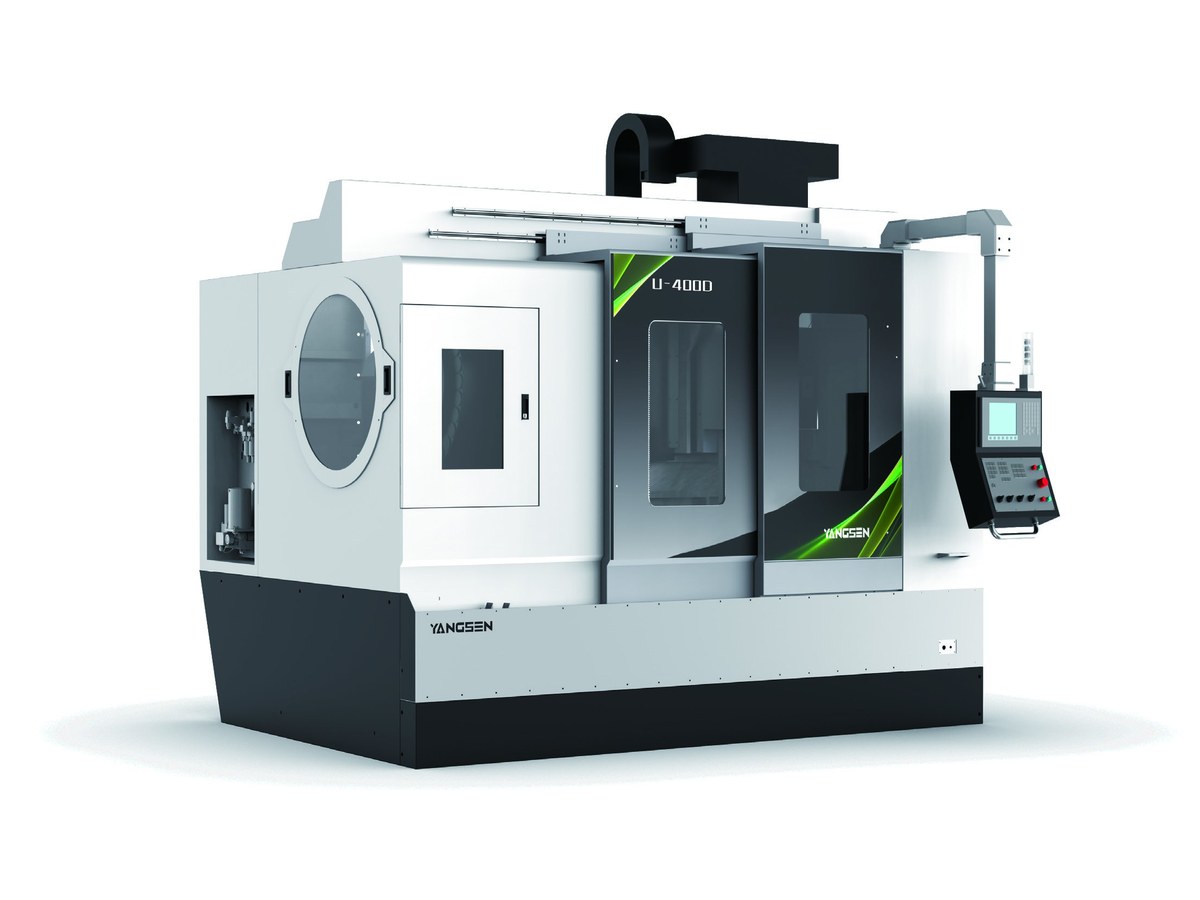
Bridge frame — U-400D → mould cores, graphite electrodes, long finishing cycles. The rigidity specialist: 1,050 mm X travel, 30 kW spindle, and a -20~±110° tilt that reaches negative draft without re-fixturing. Yangsen rates its Z-axis at roughly 30 percent greater rigidity than comparable models. Cutting graphite? Specify the graphite package and mist collection at order.
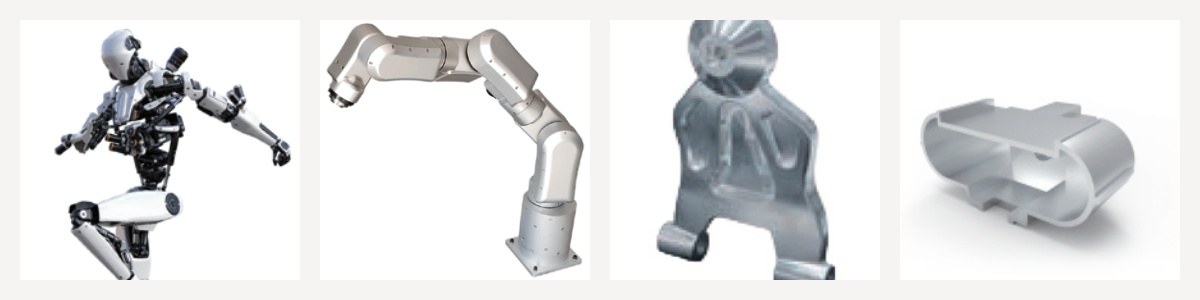
Gantry frame — U-400 / U-700 → prototypes, joints, humanoid robot components. Crossrail, saddle and ram, low moving mass. The detail that matters: the trunnion table is fixed directly to the bridge base, so its rotational accuracy is decoupled from the linear axes. U-400 is the compact option; U-700 steps up to Ø850 swing and 350 kg. Yangsen lists humanoid robot dorsal hand knuckles and head sections among its applications.
Gantry frame — U-900 → engine blocks, impellers and blisks. Realistically nothing else here. The only machine in this range that takes a genuinely heavy casting and still tilts it through ±120°.
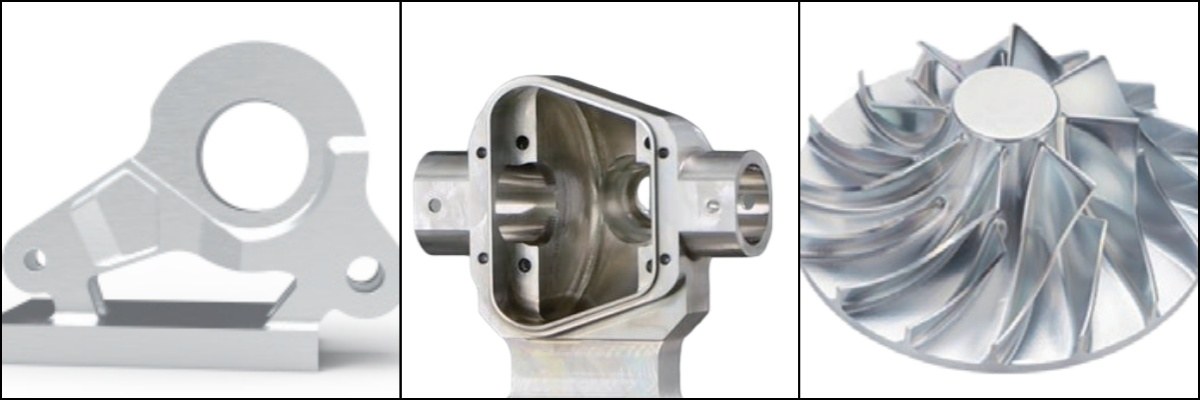
The interface steps up in three stages, and it maps onto material.
Controls: Huazhong (HNC), Syntec, Siemens, Heidenhain, FANUC, by model. Follow what your programmers already know and what your local service network supports — switching brands mid-fleet costs money that never appears on the quotation.
Availability varies by model, so confirm before you budget.
Look at what produces the accuracy before you look at the number: herringbone column construction for thermal symmetry, wide-span guideways, reinforced castings at the deformation-prone points, and direct-drive rotary axes that remove worm-gear backlash instead of compensating for it in software.
Then two things when you compare quotations.
Compare like with like. Table C is angular, in arc-seconds. Some competitors put linear positioning accuracy in millimetres in the same table. Different measurement.
A specification sheet is a claim, not evidence. Ask how it will be demonstrated — ball bar testing is the standard check for circular interpolation and squareness. Yangsen also runs remote VR factory audits, so you can watch your machine being tested without booking a flight. Cheapest due diligence available.
“A bigger table is the safer choice.” Rotating mass scales with table size. Compare the U-260T at up to 250 rpm/min against the U-900 at 60/70. On small parts with a lot of tilt moves, the bigger machine is simply slower — and you paid more for it.
“Buy a 5-axis machine and you can make complex parts.” The machine is half of it. CAM strategy, a correct post-processor and an operator who understands tool-axis control are the rest, and they are usually the bottleneck in year one. Budget for software and training now, not eighteen months later.
Q: Trunnion or table-table — what is the difference?
A: A trunnion supports the tilting axis between two bearings with the rotary platter inside the cradle. A table-table design stacks a rotary table on a separate tilting table. The trunnion is stiffer for a given size, which is why it dominates small and medium parts.
Q: How heavy a part can these machines hold?
A: 80 kg to 1,200 kg by model, fixture included. On the U-400 and U-400D, capacity is stated separately for horizontal and vertical orientation because the load path changes as the trunnion tilts.
Q: Simultaneous 5-axis, or is 3+2 enough?
A: For a large share of production work, 3+2 is enough and easier to program and hire for. Simultaneous motion earns its keep on continuous free-form surfaces — impellers, blisks, turbine blades.
Q: BT30, BBT40 or HSK-A63?
A: Match it to material and cut depth, not to budget. BT30 for small aluminium at high rpm. BBT40 for mixed aluminium and steel. HSK-A63 for titanium, tool steel and long-reach finishing.
Q: How do I get a recommendation for my own part?
A: Send four things: material, overall dimensions, the tolerance you need to hold, and expected annual volume. A drawing or STEP file makes it faster.
Those four numbers narrow eight machines to one or two before spindle speed and control brand enter the conversation — and they stop you buying a machine that looks right on paper and will not hold your part.
Then ask for three things: the specification sheet for your shortlist, a remote VR factory audit, and a model recommendation based on your drawing.
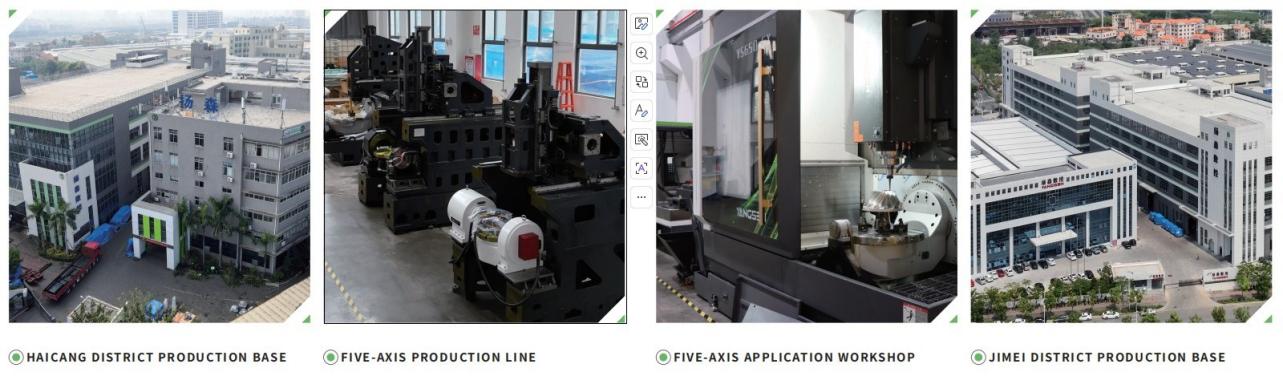
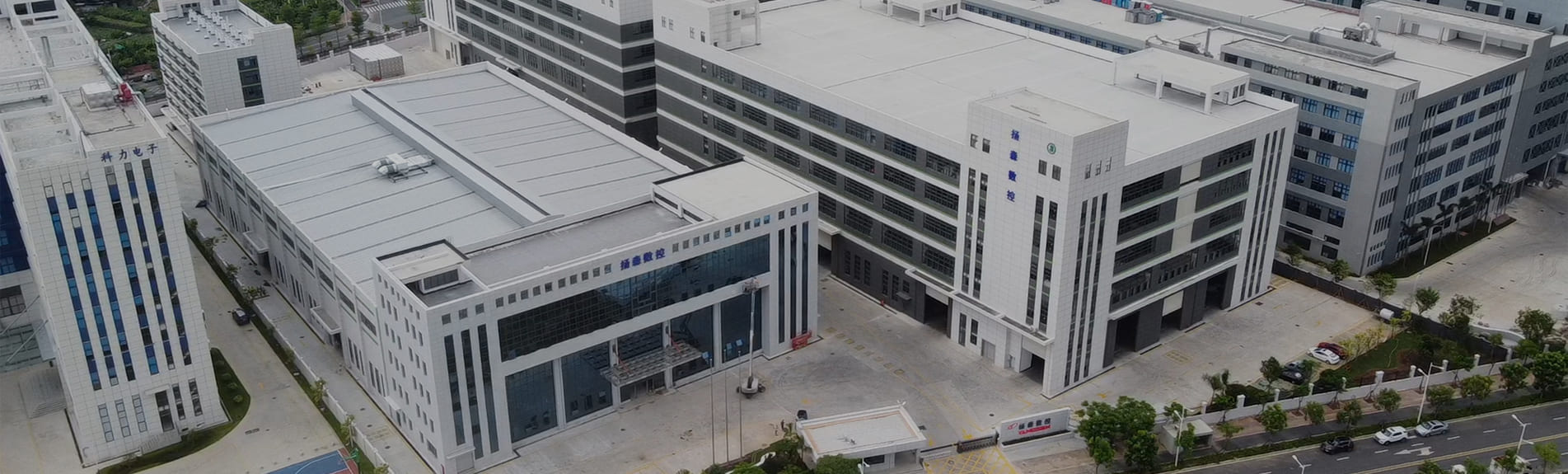
The five-axis production line and application workshop, Haicang and Jimei district bases.
Send us the part. We will tell you which of the eight it belongs on — and we will tell you if the answer is none of them.
Contact CNC Yangsen to find the right CNC machining solution for your production needs.